Language
The Greek language is an Indo-European language, with a history dating back to the 2nd millennium BC. This makes it one of the oldest European languages.
The golden age of Athens and democracy marked the millennia-long strong development of the Greek language. Greek spread throughout the Middle East and as far as India thanks to Alexander the Great and his successors. It was used as the official language of the Eastern Roman Empire. Ancient Greek was the language of ancient Greek civilisation and was spoken and written by famous philosophers, poets and historians.
Over time, Ancient Greek evolved into Modern Greek. However, the influence of Greek on other languages remained. About 12% of English vocabulary today is of Greek origin. Greek is spoken by approximately 15 million people in Greece, Cyprus and other parts of the world. There are over 700 speakers in Dresden.
Loanwords
Barbarian, dialect, grammar, calligraphy, orthography, philosophy, physics, photography, telephone, phobia, phenomenon, metre, gram, graphics, mathematics, astronomy, geography, biology, politics, democracy, athlete, marathon, technology, electricity, antibiotics
Audio sample
Script
The Greek alphabet is based on the Phoenician alphabet, which originated in the 8th century BC. The Greeks adopted the Phoenician alphabet but adapted it to their needs by adding vowels. This innovation made it possible to represent sounds more accurately and to write a wide variety of words.
Over time, Greek writing evolved and became an important tool for the dissemination of knowledge, literature and philosophy in ancient Greece. The introduction of upper and lower case letters came later, making the script even more versatile.
The word ‘alphabet’ is composed of the first two letters of the Greek alphabet, alpha and beta. The Greek alphabet consists of 24 letters, some of which are also used in mathematical and scientific contexts, e.g. in the number pi or the angular velocity omega.
ANSPRECHBAR
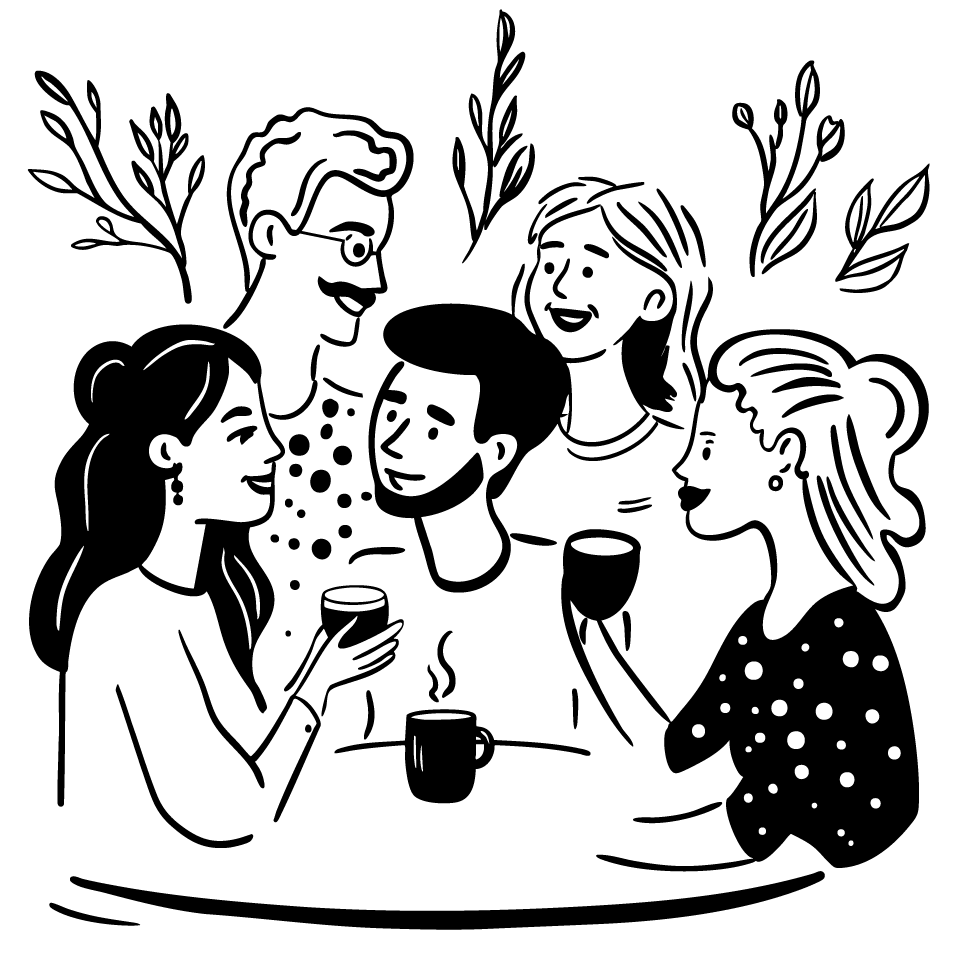
We are ANSPRECHBAR – for a better understanding! We get people talking – regardless of language, culture, age, budget or social status – at creative workshops, exhibitions and in an interview magazine with empathetic portraits. Join us and let’s build bridges together!
Period
01-12.2025
Project coordination
Yvonn Spauschus (project management)
Yulia Vishnichenko · Moussa Mbarek · Nadine Wölk · Rosa Brockelt · Bela Álvarez (workshop leader)
Rosa Hauch · Birthe Mühlhoff (moderation, documentation)
Cooperation partners
JugendKunstschule Dresden – Standort Passage, Omse e.V., Malteser Hilfsdienste e.V., Montagscafé am Staatsschauspiel Dresden, Umweltzentrum Dresden – ABC Tische, Internationale Gärten Dresden e.V, Uniwerk e.V. (Pirna), Buntes Meißen Bündnis Zivilcourage e.V. and many more
Supported by
The project is funded by Heidehof Stiftung GmbH the State Ministry for Social Affairs and Social Cohesion. This measure is co-financed with tax funds on the basis of the budget passed by the Saxon state parliament within the framework of the state programme Integrative Maßnahmen.