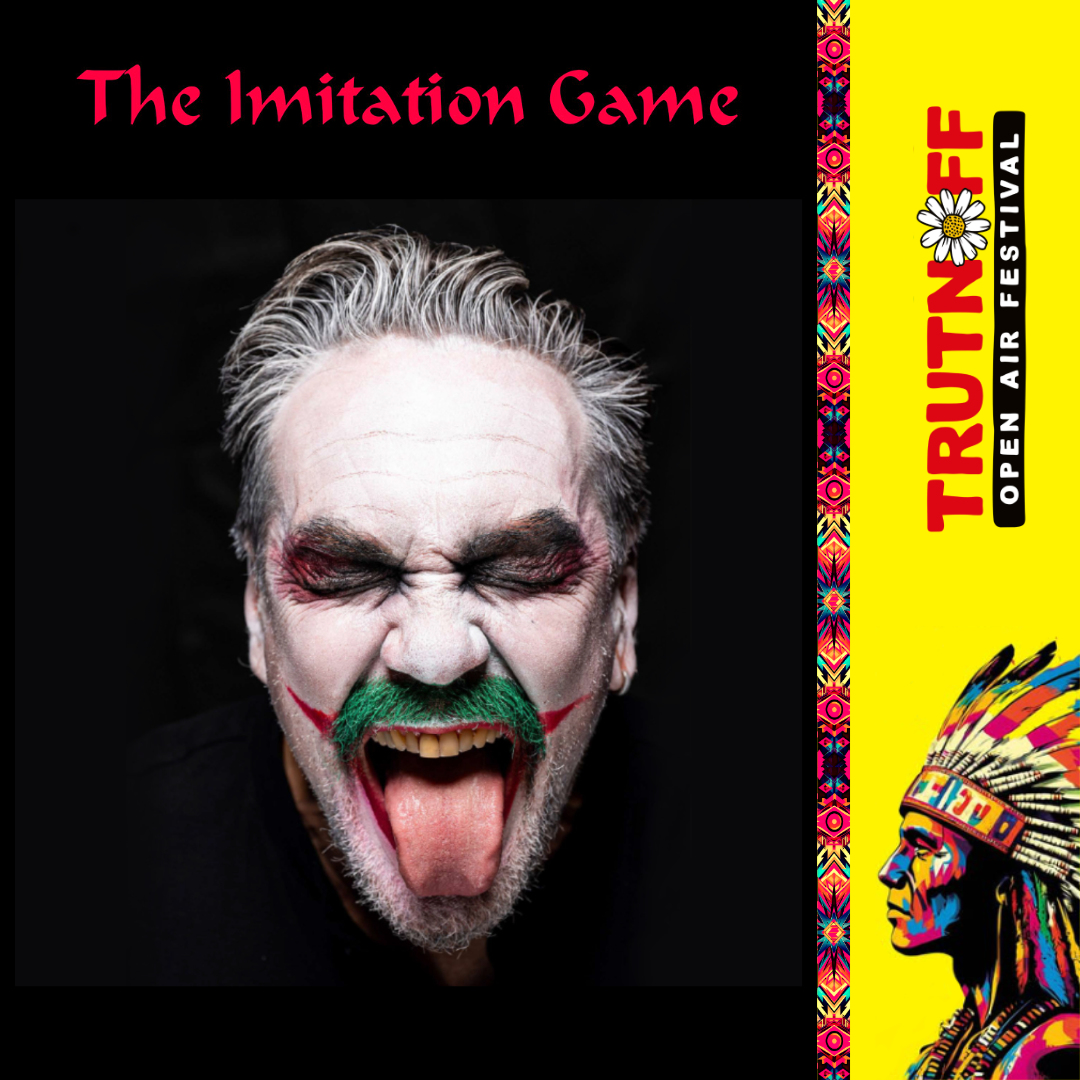
‘The Imitation Game’ meets TrutnOFF Open Air Festival


Královédvorská 90, 541 01 Trutnov, Czech Republic

Buy festival ticket: festivaltrutnoff.cz
Buy festival ticket: festivaltrutnoff.cz
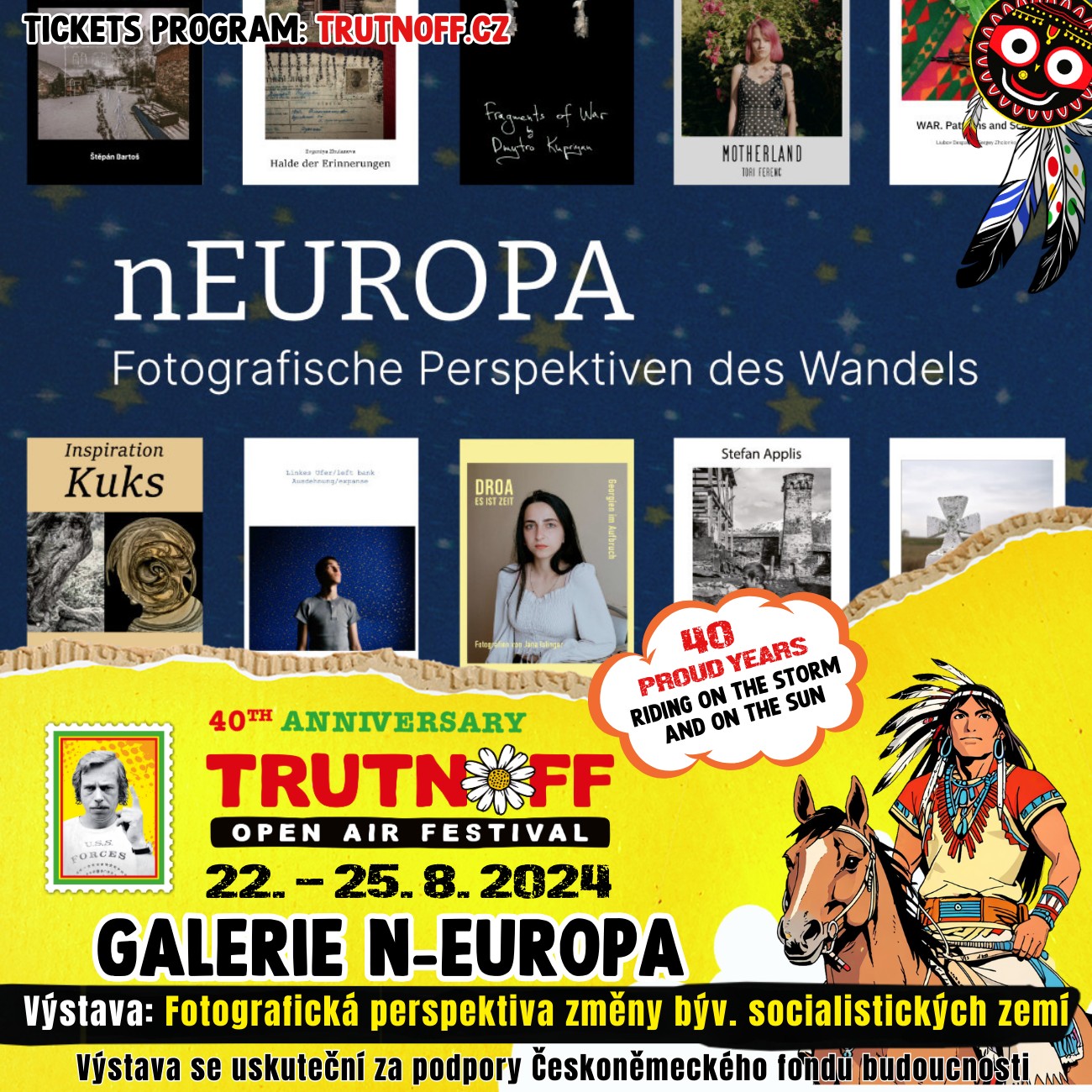
The nEUROPA gallery is going on tour again. Join us for the second time in a row at the Czech Woodstock. The TrutnOFF Open Air Festival will take place from 21 to 24 August 2025 in the Bojiště Nature Park in Trutnov at the foot of the Giant Mountains. The oldest Czech rock festival is celebrating its 41st anniversary this year.
We will be presenting the exhibition ‘The Imitation Game’. You will have the opportunity to meet nEUROPA curators Jan Oelker and Matthias Schumann as well as make-up artist Ulyana Svarychevska (UA) at the festival.
Make Love Not War – All You Need Is Láska!
The star of this year’s TrutnOFF will be the English band Public Image Ltd. It was founded by singer John Lydon (a.k.a. Johnny Rotten) after the break-up of the punk rock rebels Sex Pistols. The British metal band Saxon and the Mongolian hard rock band Hanggai will also be performing. The tam-tams are booming, the smoke is rising…!
The Imitation Game – On Masking, Camouflaging, Deceiving
There is war in Europe once again.
Eighty years after the end of the Second World War, despots and oligarchs are once again presuming to enforce their selfish power and economic interests by force. With the supposed ‘right’ of the stronger, they are launching a frontal attack on the peaceful coexistence of the peoples of Europe and their right to self-determination, thereby combating all liberal and democratic ideas within their spheres of influence.
Eighty years after the end of the Second World War, people are once again dying from bombs, grenades and hails of bullets. Every day, thousands are being slaughtered on the battlefields. Once again, cities are being bombed and cultural assets destroyed. Once again, people are forced to flee their homes, once again countless individual life plans are being shattered. What effects do war, violence and fear have on people, societies, culture and art? What resilience strategies do artists develop when faced with existential threats? How do they find meaning in their art amid this madness?
‘The whole world is a circus, and the people in it are clowns,’ quotes Anatolii Zvizynskyi, the guiding spirit and curator of the underground art space “Vagabundo” in Ivano-Frankivsk, western Ukraine, quoting what he calls a ‘little-known playwright of our time.’ Photographer Dmytro Petryna has taken up this metaphor. He portrayed various artists – painters, actors, musicians and writers – wearing clown masks. They are all friends and colleagues from all over Ukraine and are connected in some way to the art scene surrounding the Vagabundo gallery. The varied transformations into clowns were conjured up by Ulyana Svarychevska, make-up artist at the Ivano-Frankivsk Theatre.
With his portrait series ‘The Imitation Game’, taken last year, Dmytro Petryna cannot provide concrete answers to the questions raised. The constantly changing situation in the country is too complex, and the reactions to it too individual. But with these portraits, Petryna has created an ambiguous, life-affirming inventory of the attitude towards life in his environment, which is also exemplary for the middle generation of Ukrainian artists during the war.
The photo exhibition The Imitation Game explores the complexity of human emotions through the image of a clown – a symbol of both joy and sadness. At first glance, the clown, with his colourful make-up and broad smile, appears cheerful and carefree. However, behind this mask can lie a whole range of emotions – from deep sadness to genuine fear. The exhibition aims to reveal these hidden emotions through large-format portraits of people wearing clown make-up. The image of the clown emphasises the contrast between outward appearance and inner state, exaggerates extreme emotional states and serves as a metaphor for the “masks” that people often wear in everyday life.
Clowns are supposed to make people laugh, even when there is nothing to laugh about. Anatolii Zvizynskyi sees ‘laughter’ above all as a liberating force.
“Laughter is a means of transporting people into a carnivalesque utopia. This temporarily frees them from monotonous, presumptuous everyday life and the power of social institutions. It is an ecstatic attempt at short-term psychological liberation from the dramatic circumstances of the present. “Playing cinema”, putting on a mask and making faces is an attempt to make someone laugh and embody the hope for the best – a utopian endeavour in these cynical times. But many people are not in the mood to laugh. But life goes on, and that is why we must find ways to live it unforgettably – each in our own way. In this counterworld, laughter destroys the real world and creates a free and disordered world. The function of the laughter created by the mockers was to provide society with an outlet. Laughter dispelled psychological tensions and fears. Laughter is an element that can mix and replace motivations. Although laughter cannot save or restore nerve cells, a brief outburst of positive feelings or even mockery can change the mood, emotions and experience of the moment. Even through tears.
Idea and photos: Dmytro Petryna (UA)
Make-up: Ulyana Svarychevska (UA)
Curation: Jan Oelker (DE)
Exhibition contribution by the Dresden gallery nEUROPA for the TrutnOFF Open Air Festival 2025 in collaboration with the art space Underground Passage ‘Vagabundo’ in Ivano-Frankivsk (UA)
Das Projekt wird gefördert durch das Staatsministerium für Soziales und Gesellschaftlichen Zusammenhalt. Diese Maßnahme wird mitfinanziert mit Steuermitteln auf Grundlage des vom Sächsischen Landtag beschlossenen Haushaltes im Rahmen des Förderprogramms »Wir für Sachsen«.