Language
Throughout history, there have always been languages that were used as a so-called “lingua franca”, meaning that they were learned and spoken by a particularly large number of people – like a universal tool. In medieval Europe, all scholars spoke Latin and were able to exchange knowledge, even if they had very different native languages. Today, English plays this role in most parts of the world. In German, this can also be seen in so-called Anglicisms – many English words are adopted into German. Conversely, the vocabulary of English continues to grow through influences from different regions of the world.
English was initially only spoken in England. The Germanic “Anglo-Saxons” displaced the original Celtic speakers. From the 17th century onwards, the English language spread throughout the world in the wake of the rise of the British Empire and colonisation. Today, it is also the official language of the USA, Canada, Australia, New Zealand and Ireland.
There are around 340 million native English speakers in the world. The number of people who learn English as an additional language varies between 510 million and 1.75 billion, depending on the estimate.
German loanwords from English (so-called Anglicisms)
App, challenge, feedback, highlight, meeting, shopping
German words that sound like English but are not used in English at all
Handy
Audio sample
Script
Like many writing systems, the English alphabet originally developed from the Phoenician alphabet. The Phoenician alphabet influenced the Greek alphabet, which in turn developed the Latin alphabet. The Romans adopted the Greek alphabet and adapted it, leading to the creation of the Latin alphabet. With the Christianisation of England in the 6th century AD, the Latin alphabet entered the English language. In the 15th and 16th centuries, particularly with the invention of printing, standardisation of the alphabet began. The modern English alphabet with 26 letters was established.
ANSPRECHBAR
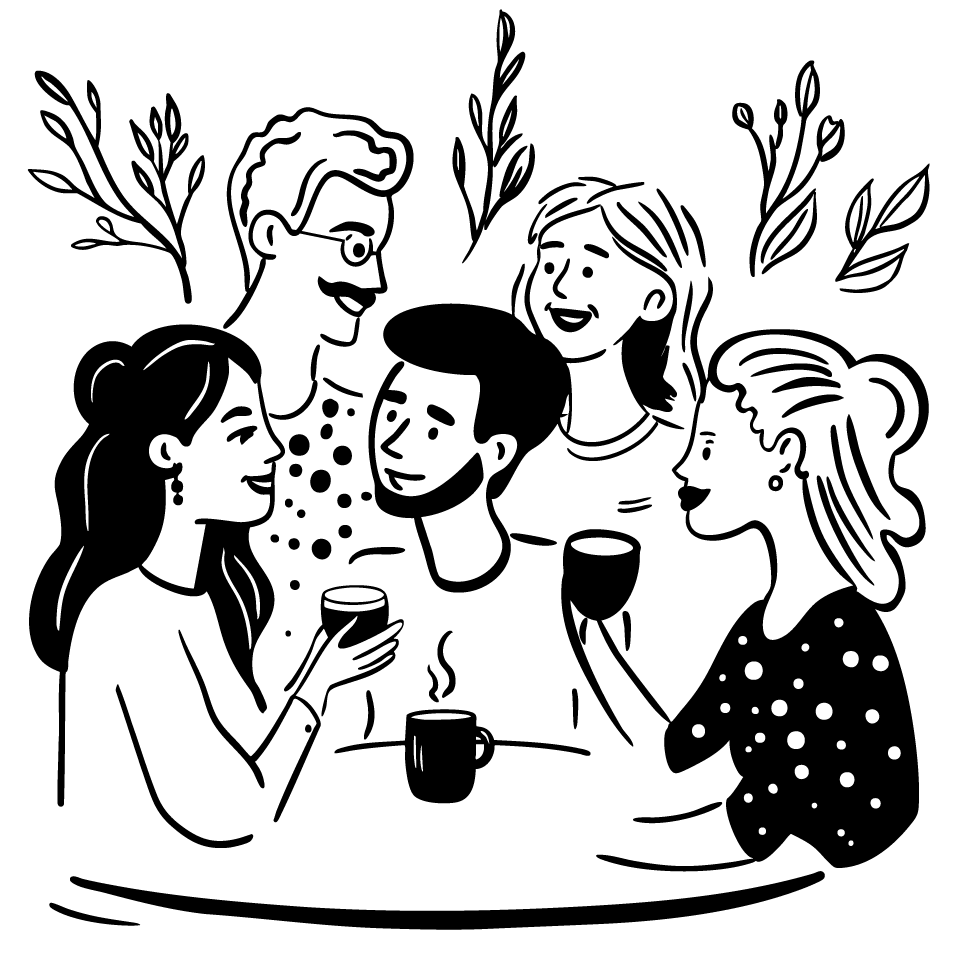
We are ANSPRECHBAR – for a better understanding! We get people talking – regardless of language, culture, age, budget or social status – at creative workshops, exhibitions and in an interview magazine with empathetic portraits. Join us and let’s build bridges together!
Period
01-12.2025
Project coordination
Yvonn Spauschus (project management)
Yulia Vishnichenko · Moussa Mbarek · Nadine Wölk · Rosa Brockelt · Bela Álvarez (workshop leader)
Rosa Hauch · Birthe Mühlhoff (moderation, documentation)
Cooperation partners
JugendKunstschule Dresden – Standort Passage, Omse e.V., Malteser Hilfsdienste e.V., Montagscafé am Staatsschauspiel Dresden, Umweltzentrum Dresden – ABC Tische, Internationale Gärten Dresden e.V, Uniwerk e.V. (Pirna), Buntes Meißen Bündnis Zivilcourage e.V. and many more
Supported by
The project is funded by Heidehof Stiftung GmbH the State Ministry for Social Affairs and Social Cohesion. This measure is co-financed with tax funds on the basis of the budget passed by the Saxon state parliament within the framework of the state programme Integrative Maßnahmen.