Language
German is like a crime novel. Most of the time, the verb comes at the very end of the sentence and explains what it’s all about. And then there are the compound words. A challenge for those who want to learn our language. Is it soup spoon or spoon soup? But back to the beginning.
When the Romans came north, the language of the Germanic tribes also changed. Latin found its way into the language and has accompanied our language to this day. Around 600 AD, Old High German emerged. At this time, the word “deutsch”, which means “people”, also appeared for the first time with its current meaning. 500 years ago, Martin Luther laid the foundation for a uniform German language with his translation of the Bible. When the German-speaking areas united 150 years ago, a uniform spelling system was also established. Konrad Duden’s “Orthographic Dictionary of the German Language” remained valid for almost 120 years, until 1996. And the language continues to change: the dative is the death of the genitive.
The German language consists of around 5.3 million words, and the trend is rising. That is about eight times as many words as there are in English.
Around 200 million people worldwide speak German, either as their mother tongue or as a foreign language. German is the official language in Germany, Austria, Liechtenstein, Switzerland, Luxembourg, Belgium, Italy (South Tyrol) and parts of South America. It is the most widely spoken mother tongue in the European Union (EU).
Script
After antiquity and the so-called Migration Period, which caused many special developments in writing, a consolidation and standardisation of the commonly used scripts took place around 800. Our modern script is based on Latin.
Archaeologists of writing distinguish between block letters, which are characterised by regularity and emphasis on individual letters, and cursive writing, in which individual letters can be joined together. From then until the 20th century, Gothic and Latin fonts coexisted, especially in book printing. However, the pointed Kurrent script became the standard cursive script in German-speaking countries.
In 1935, the National Socialists declared Sütterlin script to be the German national script and banned Gothic Fraktur script in 1941. From 1942 onwards, the rounder Latin script became the standard in German schools again.
ANSPRECHBAR
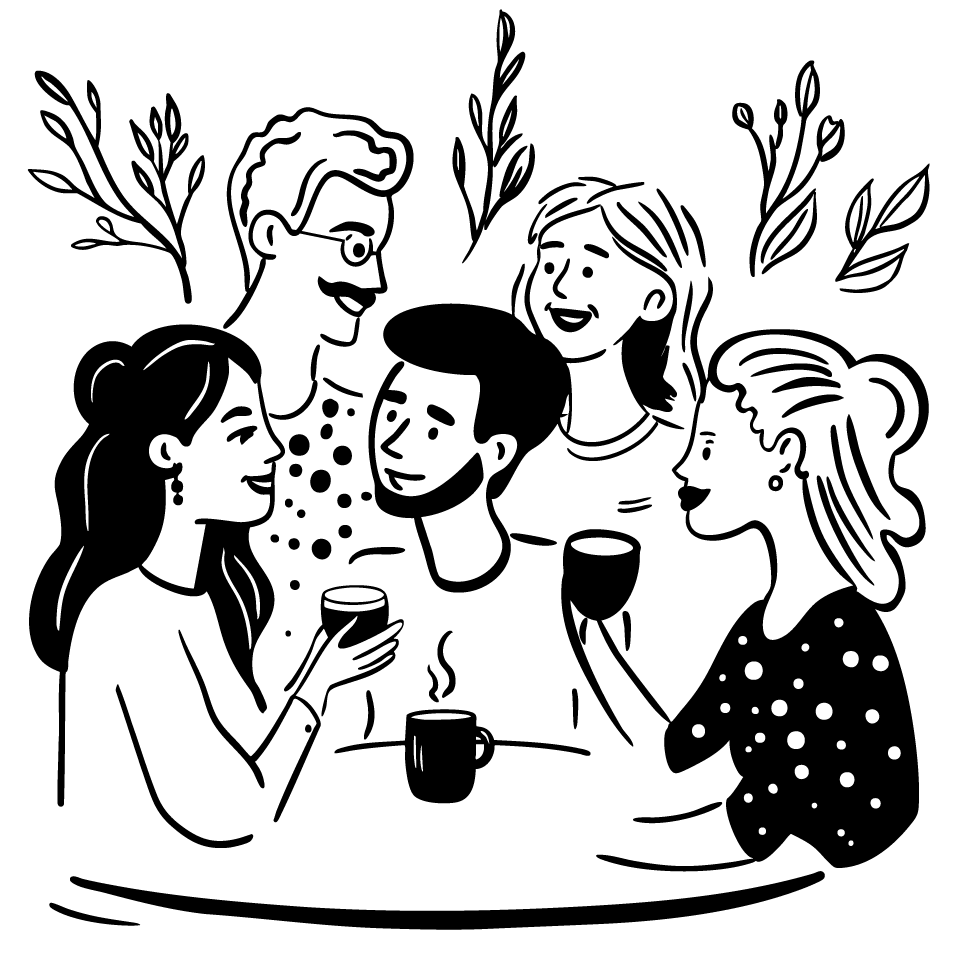
We are ANSPRECHBAR – for a better understanding! We get people talking – regardless of language, culture, age, budget or social status – at creative workshops, exhibitions and in an interview magazine with empathetic portraits. Join us and let’s build bridges together!
Period
01-12.2025
Project team
Yvonn Spauschus (project management)
Yulia Vishnichenko · Moussa Mbarek · Nadine Wölk · Rosa Brockelt · Bela Álvarez (workshop leader)
Rosa Hauch · Birthe Mühlhoff (moderation, documentation)
Cooperation partners
JugendKunstschule Dresden – Standort Passage, Omse e.V., Malteser Hilfsdienste e.V., Montagscafé am Staatsschauspiel Dresden, Umweltzentrum Dresden – ABC Tische, Internationale Gärten Dresden e.V, Uniwerk e.V. (Pirna), Buntes Meißen Bündnis Zivilcourage e.V. and many more
Supported by
The project is funded by Heidehof Stiftung GmbH and the State Ministry for Social Affairs and Social Cohesion. This measure is co-financed with tax funds on the basis of the budget passed by the Saxon state parliament within the framework of the state programme Integrative Maßnahmen.