
Our renowned and world-famous lecture series “Winter Journeys” is set to take place again this winter. Through this series, we want to give you—and ourselves—another opportunity to share and hear stories about exciting, eventful, interesting, surprising, or even spectacular summer journeys during the cold season. To that end, we’re still looking for globetrotters who’d like to host an evening filled with photos and enthusiasm. The “Winter Trips” are scheduled to take place between January and March, when the days are shortest and the wanderlust is strongest.
Program
06.02.2013: “Iran: Hitchhiking”, Stefanie Feller
There’s no Persian word for “hitchhiking,” but there are 78 million Iranians who’ll give you a ride anywhere you can imagine, tell you their stories, and invite you in for tea and sweets. So, dressed in a hijab, with a headscarf and a long coat, I made my way past the morality police and glittering mosques, across a land of contrasts where modern Iranians are torn between the Western lifestyle they see on satellite TV and underground parties, on the one hand, and strict rules of gender segregation in public, on the other. And on top of that, there was the rainforest on the Caspian Sea, Esfahan—arguably the most beautiful city in the world—Iranian hiking apprentices… and the phrase that helps in every situation: “Bichial” (stay cool)
13.02.2013: “Georgien”, Mirko Sennewald
Few countries can boast such diverse natural landscapes within a comparatively small area: from the Black Sea to the high mountains of the Caucasus, through lush forests, all the way to the steppe deserts in the eastern part of the country. Numerous sites are listed as World Heritage Sites, including the defensive towers in Svaneti, the cave monasteries of Davit Garedja and Uplistsikhe, and the cave city of Vardzia. The capital, Tbilisi, tells the story of the country’s eventful history—right up to the present day—through its architecture, while in Gori, Stalin’s birthplace, the dictator’s last intact monument was not removed until 2010… The slide show (the traditional kind, with actual slides and a slide projector) features a selection of photos from numerous trips to Georgia, which were just as varied as the country itself.
20.02.2013: “Slovakia: A Small but Great Country”, Katarina Havranova
There are many beautiful and interesting things in the world. This evening, Slovakia—“A Small but Great Country” in the heart of Europe—will be presented to you by a local resident, Katarína Havranová.
Slovakia is a small country in terms of area, but this is not true of its significance or its wealth of curiosities. Not only will it be presented as an attractive destination for your vacation, but you’ll also learn new things about the culture, cuisine, notable Slovak figures, and much more. Following the presentation, a short film about the High Tatras—the smallest high mountain range in Central Europe—will be shown. At the end of the presentation, there will be an opportunity for a lively discussion. You’re cordially invited!
27.02.2013: “Belarus: Two Photographers in the Heart of the Eastern Periphery”, Matthias Schumann & Jan Oelker
Swamps, the “potato stronghold,” Europe’s last dictatorship, Chernobyl… What do we know about Belarus? In September 2012, three photographers from Dresden, a visual artist, a DJ, and the Berlin band Sandow traveled to the eastern heart of Europe—to Belarus. In Vitebsk, the birthplace of Marc Chagall; the memorial village of Khatyn; Minsk, the capital and “City of the Sun”; and the small forest village of Gorodka, they explore the question of how much of Europe is in Belarus and how much of Belarus is in Europe. A travelogue by Matthias Schumann and Jan Oelker (tbc).
06.03.2013: “Nepal: Trekking in the Himalayas”, Elke Israel
We spent 17 days trekking in the mountains of Nepal. We covered nearly 5,000 meters of elevation gain on foot, hiking through the Rolwaling Valley, across the Trakarding Glacier, and up to the 5,755-meter-high Trashi Laptsa Pass. On the other side of the pass, the Khumbu Valley welcomed us with views of the world’s highest peaks. Impressive and breathtaking in the truest sense of the word.
13.03.2013: “Mexico” Home game for hosts David Schwartz
20.03.2013 „The Balkans: A Paradise with Rocky Roads“ (Elena Pagel, Christin Straube, Jan Hauptmann, Marcus Oertel)
Last summer, four friends set out on a trip through Slovenia, Croatia, Bosnia, and Serbia, full of anticipation, and were richly rewarded with experiences and impressions that can be addictive. The Balkans offer many things that we sometimes miss in Germany: spontaneity, warm openness, vivid emotions, and, last but not least, their proverbial hospitality—all of which make it almost a paradise for open-minded independent travelers, practically right on our doorstep in Europe.
Yet light and shadow are closely intertwined here, and the deeper you delve, the more pronounced the contrasts become—contrasts that speak to the sometimes brutal realities of the Balkans: poverty and social hardship, deep scars from the past, and openly displayed nationalism make the longed-for journey toward Europe a long and rocky one. Together with you, we want to look at our photos on March 20 and retrace our addictive route in our minds.
27.03.2013: “Norwegen-Hurtigrute” Jürgen Duhnke
From Bergen, we took the mail ship to Kirkenes, passing the highlight of the trip: the North Cape (Honningsvåg), the last civilized point outside of Greenland. One of the highlights was crossing the Arctic Circle, with a baptism by Neptune, of course. The mail ship stops at every—and I mean “every”—town, unloading and loading everything from engine parts to packages and other items. During the day, you have the opportunity to make the most of the scheduled docking time and explore the respective town; however, this is not possible in the event of delays or storms.
The MS Lofoten is the last mail ship without stabilizers and resembles our white fleet. It will only remain in service until 2017. The newer mail ships resemble floating hotels and no longer have anything to do with Christian seafaring. During this 7-day voyage, 2,200 photos were taken, but only a fraction of them are shown here.
03.04.2013 „Eastern Poland“ Simon Wolf
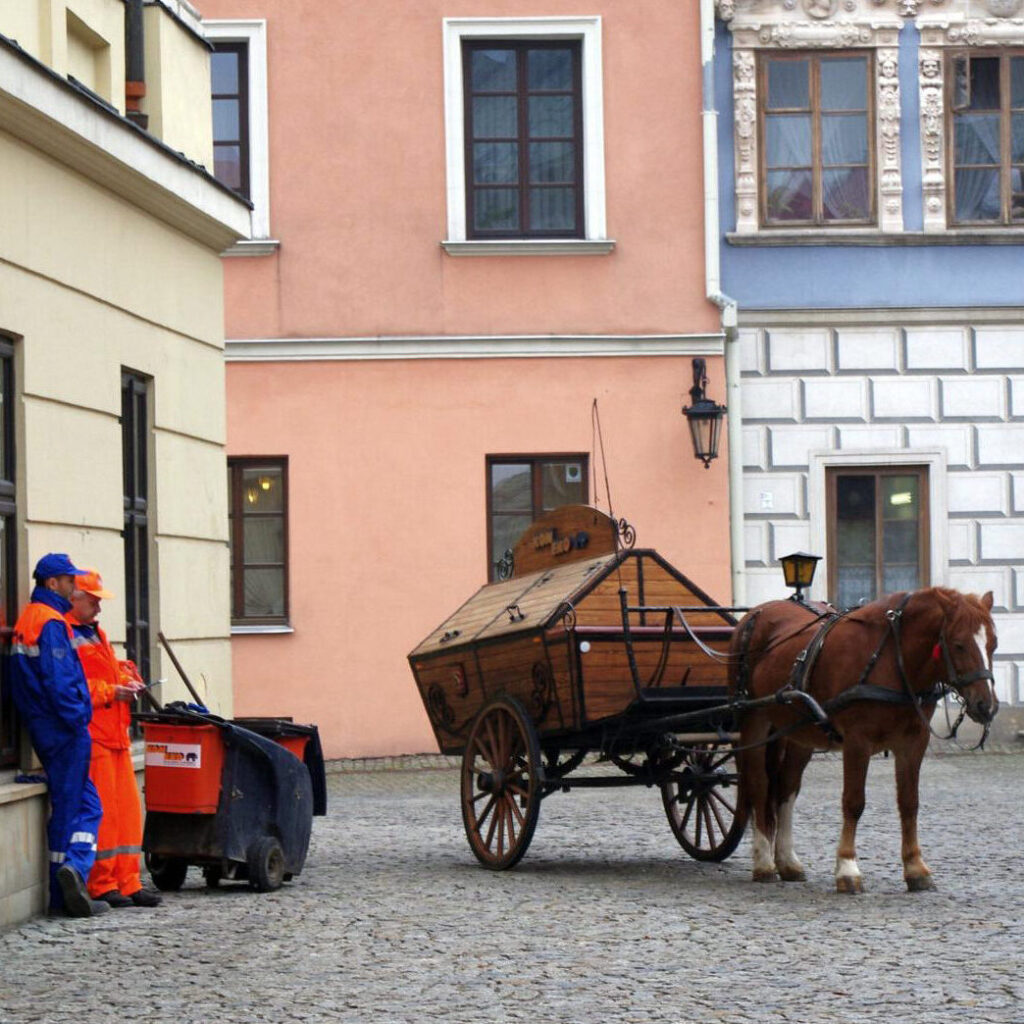
Lublin—Poland’s largest city east of the Vistula River. Barely 100 kilometers from Belarus and Ukraine. The rich history of Central Europe has left its mark here. Today, countless students—who make up one-sixth of the city’s population—define the city’s character. A region shaped by agriculture and unemployment.
After a year as a European volunteer in Lublin, I’d like to share some quirky and thought-provoking stories: garbage collection powered by horses; blues music at the kebab stand; prime residential neighborhoods with a view of the former Majdanek concentration camp right in the middle of the city…
A trip to the EU border.