Text: Lu’u Thanh Mai
Edited by: Kultur Aktiv e.V.
Images: Lê Huy Văn (Hanoi), Chu Tan Thanh & Le Trang (Hồ Chí Minh-City)

On 27 September 2026, the ‘Moritzburg Children’ meet in Hồ Chí Minh-City to celebrate together. Also present: our contemporary witness, Cù Huy Phán Táo (seated, front row).
Speech marking the 70th anniversary of the arrival of pupils from the Maxim Gorky School in Dresden (GDR)
Speaker: Lu’u Thanh Mai
(Representative of the Joint Committee of Former Pupils of the Maxim Gorky School)
70 YEARS OF GROWTH AND COMMITMENT TO THE RECONSTRUCTION OF THE COUNTRY BY FORMER PUPILS OF THE MAXIM GORKY SCHOOL – DRESDEN – GDR
Dear Mr Felix Wagenfeld, Head of the DAAD Hanoi Office,
Distinguished representatives of the Hanoi University of Science and Technology,
Dear friends,
Today, in the pleasant autumnal atmosphere of Hanoi, we – the former pupils of the Maxim Gorky School and the Käthe Kollwitz School, all of whom are now over 80 years old – are delighted to be able to come together once more to celebrate the 70th anniversary of the arrival of the pupils of the Maxim Gorky School in Dresden – in the GDR – together.
At the same time, we remember with deep sorrow our 59 dear friends who have left us forever.
No matter where we live today or how far time and distance have taken us apart, we look back with pride on the paths we have taken – on times full of joy and sorrow, on successes and also on failures.
CHILDHOOD YEARS SPENT IN LOVING CARE AND COMPLETE COUNSELING
In September 1956, a group of 198 schoolchildren travelled to the GDR as the second group to be received by the GDR government, which provided for their schooling and general education. This took place at a time when our country had just emerged from a long, extremely difficult and deprived war of resistance.
All these children were the offspring of distinguished revolutionaries, fallen heroes and martyrs, patriotic intellectuals, and people who had rendered great services to the revolution.
For the first time, the children had to leave their families and parents and travel almost halfway around the world to reach distant Germany.
Contrary to all initial concerns and the unfamiliar situation, the children were welcomed with open arms, full of love and humanity, by the German and Vietnamese teachers, as well as all the staff at the Maxim Gorky School in Dresden, Germany.
They received dedicated and comprehensive care, down to the very last detail, just like beloved children in a family. At mealtimes, crockery, knives, spoons and the food were already laid out on the table. Every meal was scientifically calculated and portioned to ensure the best possible health. Clothing and personal items were provided in complete accordance with the seasons. Clothes and bed linen were washed regularly and replaced regularly. Indeed, the school did not allow the children to suffer any kind of deprivation.
As far as education went, the pupils received a comprehensive education:
At school, they studied literature, history and geography in Vietnamese, following the standard Vietnamese school curriculum. The science subjects – such as mathematics, physics, chemistry and biology – as well as other specialist subjects such as music, instrumental lessons, sport and extra-curricular activities were taught entirely in German.
The German teachers were truly outstanding educators. None of them spoke Vietnamese, whilst the pupils had absolutely no knowledge of a foreign language. At that time, there weren’t even any dictionaries to help them. Nevertheless, using vivid teaching methods – such as pictures, objects and everyday gestures of communication – the teachers managed to enable the children to acquire a basic knowledge of German for everyday use after just six months. After that, they continued to study German grammar and language structure in greater depth and in a systematic way in order to improve their language skills.
The pupils were also able to take part in a wide variety of extracurricular activities. Each group of pupils had a small garden. There, under the guidance of a teacher, they learnt to grow flowers and look after ornamental plants. The girls were taught home economics and needlework and made small knitted and embroidered memorabilia. The boys were able to let off steam playing football, basketball and other active games. In the summer, the pupils were taken on trips to farms, where they harvested potatoes alongside the farmers and enjoyed freshly baked bread with honey and fruit jam. To this day, these sweet and happy memories remain deeply etched in our hearts.
To broaden their horizons and deepen their knowledge, the school organised visits for the pupils to museums, magnificent historic castles, war memorials and the former Buchenwald concentration camp of fascist Germany. They watched documentaries about the Second World War and studied the German revolutionaries of earlier generations in order to gain a better understanding of German history.
The older classes also visited a number of factories, where they were able to see machinery in operation and learn about the workers’ working methods. Every year, the pupils had summer and winter holidays. They learnt to ski and went on excursions to snowy forests. All these experiences were extremely exciting and new for the children at the time.
One of our most vivid memories is of 29 July 1957. On that day, our two schools had the great honour of welcoming Uncle Ho during his visit to the school in Moritzburg. We were allowed to have our photograph taken with him and put on cultural performances for him.
To this day, we cherish his words deep in our hearts: ‘We must try very hard to study well and be grateful to the German teachers and the German people.’ Following Uncle Ho’s visit, the German media gave the pupils of both schools the common name ‘Moritzburg Children’ – a name that remains full of wonderful memories to this day.
The three years we spent at the Maxim Gorky School were three years full of fond memories and valuable experiences. However, the most important and precious things we still cherish today are the deep bonds and friendships we formed with our German teachers and our German friends, as well as our boundless gratitude towards the German people.
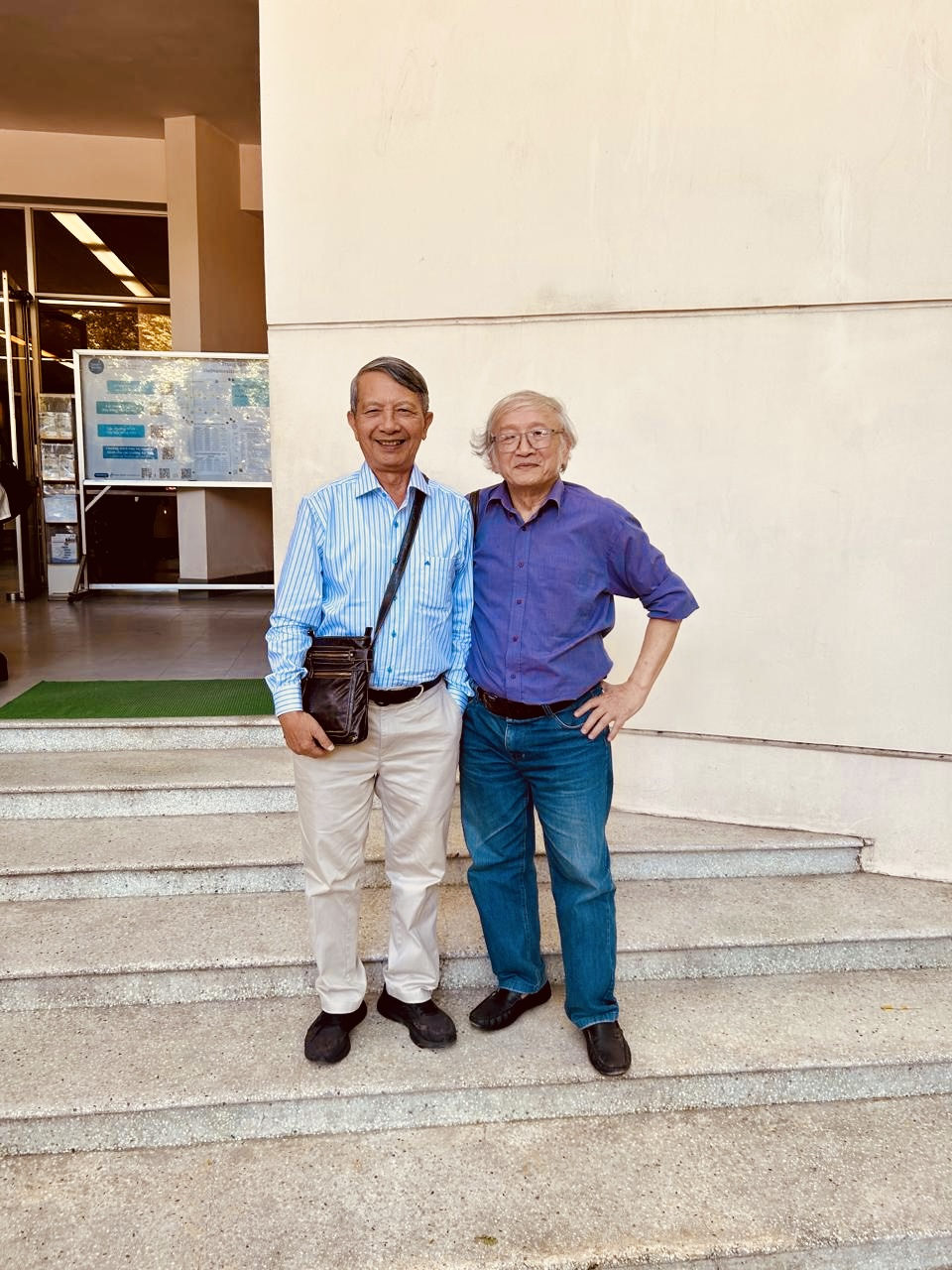

Among the invited guests in Hồ Chí Minh-City is our contemporary witness, Lê Huy Văn (Picture 1).
HALF A CENTURY OF RELENTLESS LEARNING, WORK AND COMMITMENT TO THE COUNTRY
After three years of general education at the Maxim Gorky School, a new phase of our lives began in accordance with the agreement between the governments of both countries. The younger pupils returned to Vietnam to continue their schooling. The older pupils were assigned to vocational training.
From that point onwards, the pupils from the two schools, Maxim Gorky and Moritzburg, formed a joint community. We were split up together to study and work in more than ten different vocational fields, mainly in the areas of mechanical engineering, precision engineering, optics, dye chemistry, the textile industry, printing technology and the glass industry… The study groups at the vocational schools and the work groups in the companies worked closely with our German friends.
During the three years of vocational training, we not only acquired a great deal of specialist knowledge, developed professional skills and learnt working techniques, but also adopted the valuable qualities of the German people: honesty, precision and a high degree of discipline. These valuable qualities later helped us to tackle and successfully complete many difficult tasks.
After completing our three-year vocational training, we returned to Vietnam and were assigned to various government departments, state-owned enterprises and defence industries throughout the north.
In 1965, the American war escalated with the massive bombing of North Vietnam. From that point on, the government departments and enterprises, which had been relocated to various locations, had to work, produce and fight simultaneously. They formed a solid and reliable foundation for the war of resistance against the USA.
Some of our male friends joined the army and took part directly in the fighting against the USA on various fronts – in Regions B and C, along the borders and on the islands, as well as in various branches of the armed forces such as the infantry, air defence and the air force.
Among our friends, there were four fallen heroes who gave their lives on the battlefield. These included our friend Mai Hồng Phúc (Group 5) – a pilot – and our friend Huỳnh Thị Yến (Group 2) – a doctor. Several other friends returned with injuries. When people speak of our friend Nguyễn Khắc Thảo (Group 7), everyone knows him. Although he was among those who, due to special circumstances, were not required to be conscripted into the military, he volunteered for service on the front line. He was seriously wounded during the fighting. As there were insufficient medical facilities deep in the forest, he lost both his eyes and became one of the most severely disabled war veterans. Yet Nguyễn Khắc Thảo continued to live with great strength and willpower.
At each of our meetings, we always remember the sacrifices made by our friends with deep respect and gratitude.
Throughout our professional careers, we have all constantly tried to continue learning – both in schools and universities and through practical work. Some of us went on to study at universities in Vietnam. Some returned to Germany to complete a degree or postgraduate studies. Others carried out scientific research and received significant awards.
The following figures provide a vivid illustration of the persistent efforts of many of us:
- 94 people have completed a university degree.
- 15 people have been awarded a doctorate.
- 4 people have become professors or associate professors.
- 1 person has been honoured as a ‘People’s Teacher’.
- 4 people have attained the rank of colonel in the military or police.
Within the state administrative apparatus, too, some of our friends took up senior posts and assumed significant responsibilities:
- Vice Minister: Phan Quang Trung (Group 6)
- Director-General: Nguyễn Hữu Thiện (Group 7, deceased)
- Vice Chairman of a province: Trương Bình Tâm (Group 8, deceased)
- Director of the Central Institute for Economic Management (CIEM): Lê Đăng Doanh (Group 9)
- Vice-Chancellor of the University of Industrial Arts: Artist Lê Huy Văn (Group 9)
- Director of the Ho Chi Minh City Conservatoire: Artist and People’s Teacher Hoàng Cương (Group 9)
In our mid-life, most of us held middle-management positions or possessed high levels of specialist expertise in ministries, departments, research institutes, government agencies, enterprises and the armed forces.
Among our significant honours, we are particularly proud of the following achievements:
- The Ho Chi Minh Prize for a state-funded research project:
‘Extraction of ARTEMISININ from the plant Artemisia annua for the treatment of malaria’.
This research project was led by the late Associate Doctor Đỗ Hữu Nghị (Group 5). Our colleague Đỗ Xuân Hương (Group 2) was involved in it.
- Kovalevskaja-Preis für ein staatliches Forschungsprojekt:
“Forschung und Entwicklung von Membranen für die Blutfiltration“, geleitet von Prof. Dr. Lê Viết Kim Ba (Gruppe 4).
The outcomes of these two scientific projects have been put to practical use and manufactured for the medical sector. They have saved many lives whilst also bringing significant economic benefits to our country.
An outstanding example is our friend Nguyễn Bạch Tuyết (Group 1), who, even at the age of 84, remains tirelessly active.
She was formerly Chair of the Board of Directors and Managing Director of VFG Company, a large and successful enterprise in the agricultural sector.
The company not only makes a significant contribution to the national budget, but also actively supports charitable causes for children every year and provides long-term support to Vietnamese mothers who hold the title of ‘Mother of a Vietnamese Hero’.
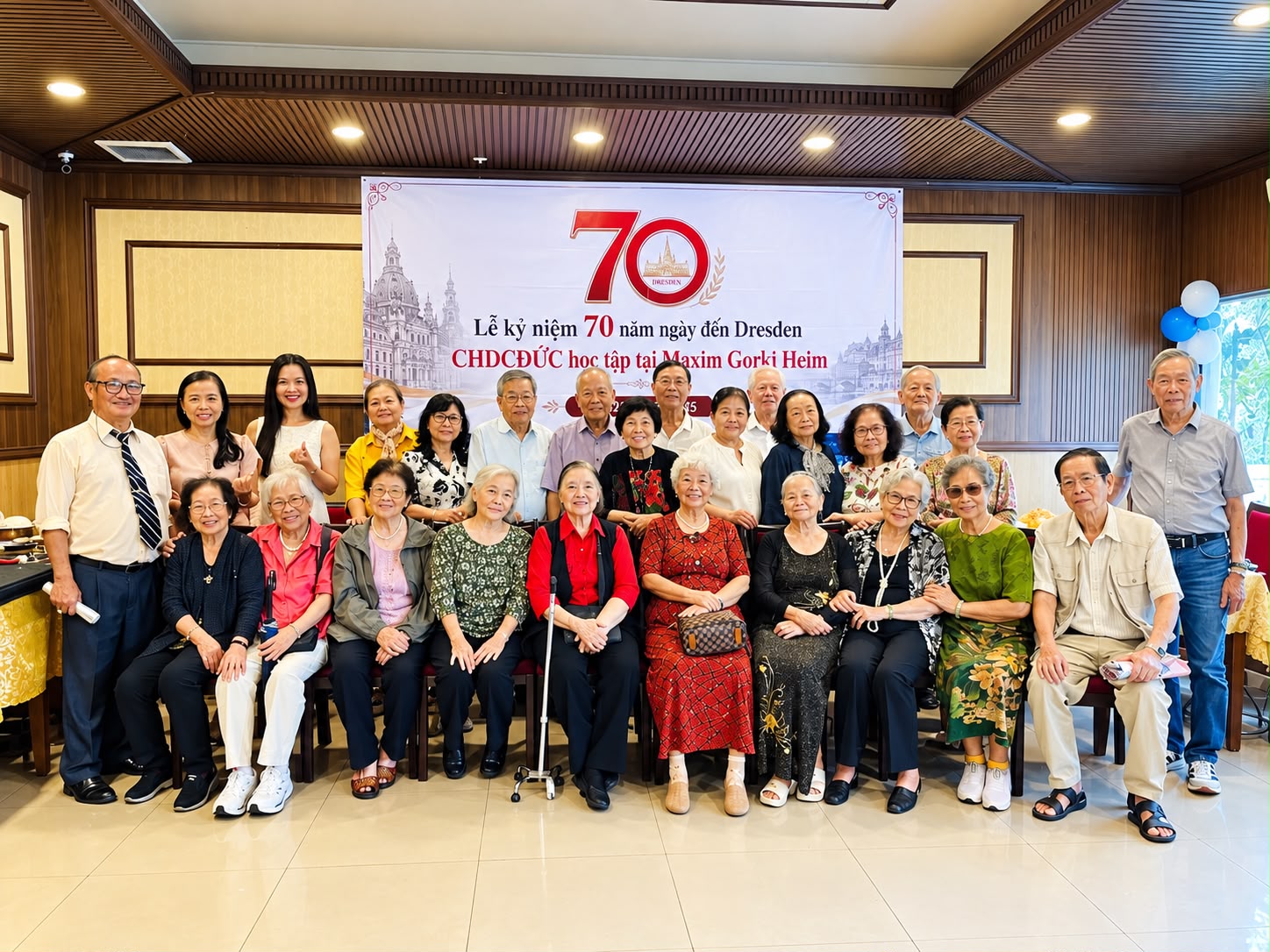
On 29 September 2026, more former pupils of the Maxim Gorky School will gather in Hanoi to celebrate together with representatives of the German Academic Exchange Service (DAAD) and Hanoi University of Science and Technology.
THE LOVE FOR GERMANY – THE BOND THAT HAS UNITED OUR FRIENDSHIP FOR OVER 70 YEARS AND STRENGTHENED THE BRIDGE OF FRIENDSHIP BETWEEN VIETNAM AND GERMANY
Seventy years have passed since the day we arrived at the Maxim Gorky School. Although time and distance have separated us, none of us has forgotten the wonderful years spent under the roof of our old school.
Today, sadly, most of our former teachers are no longer with us. During their lifetimes, however, we kept in regular contact with them and visited our former teachers in Hanoi and Ho Chi Minh City.
Those who had the opportunity to travel back to Germany – whether to study, work or for other reasons – never failed to visit the old school and meet up again with their former teachers and German friends from those days.
We have always felt a deep connection to Germany: we love German culture, the folk songs, the classical music and the magnificent buildings – from historic to modern architecture. Even in everyday life, high-quality products from Germany constantly remind us of this country.
And Germany has not forgotten us either.
In 2005, to mark the 50th anniversary of the arrival of the first group of pupils in Moritzburg, the German Academic Exchange Service (DAAD) organised a special trip for the former pupils of the two schools, Käthe-Kollwitz and Maxim Gorki, so that we could return to Germany and visit the country once again.
We were given a very warm, attentive and ceremonial welcome by high-ranking German officials, our former teachers and many German friends. This was a great honour for us and left each and every one of us with deep and moving feelings. These encounters were not only an opportunity to relive memories together, but also helped to further strengthen the close friendship between the peoples of Vietnam and Germany.
This deep love for Germany is also the bond that has united and strengthened our friendship over seven decades. After our retirement, we once again had more opportunities to meet more frequently and in full. Groups of friends organised their own trips at home and abroad, as well as warm get-togethers at the start of the new year.
A particular highlight was 2016, marking the 60th anniversary of the arrival of the pupils from the Maxim Gorky School in Germany. Together, we collected documents and photographs, wrote articles, produced a video and published a commemorative book. Both of these significant works bore the shared title: “Maxim Gorky Heim – An Unforgettable Time”.
The commemorative book, comprising over 200 pages, was written, edited and designed entirely by former pupils of the school. The book allowed us to relive the wonderful childhood years we spent at the Maxim Gorky School. At the same time, it reminded us of the difficult years of learning, working and living – years characterised by great dedication – during which we strove to serve our homeland.
This significant initiative brought together more than 120 friends from across the country, who pooled their contributions and resources to ensure the book’s successful publication.
This memoir was subsequently translated into German with great dedication by our friend Cù Huy Phán Táo (Group 1) and several other committed friends.
The artist Lê Huy Văn is someone who has maintained a warm relationship with his German friends over the decades. At the age of 84, he still possesses a sharp mind and a masterful hand that tirelessly produces creative works. Throughout his artistic practice, Văn maintains regular contact and exchanges with German professors, artists, journalists and friends.
A particularly memorable milestone occurred in 1976: after returning from his studies in Germany, Văn successfully designed the iconic “Bia Hơi” glass for Hanoi, thereby shaping a unique cultural feature of Vietnamese gastronomy. This beer glass has now been in use for 50 years and is very popular with the people of Hanoi as well as international visitors.
To mark the 50th anniversary of the establishment of diplomatic relations between Vietnam and Germany, the city of Dresden organised a highly successful solo exhibition by Văn entitled “Germany – my second home”.
To mark the 100th anniversary of the DAAD and the 50th anniversary of diplomatic relations between Vietnam and Germany, the DAAD is launching the ‘Mosaic of Memories’ photography and writing competition. In this competition, five entries from the Maxim Gorky School were selected by the DAAD from a total of 30 outstanding entries. These were entries by our friends: Cù Huy Phán Táo, Nguỵ Hữu Tâm, Lê Đăng Doanh, Vũ Việt Nam and Lê Huy Văn.
Today, as we mark the 70th anniversary of the arrival of the pupils from the Maxim Gorky School in Germany, we can proudly say that we have all become good citizens of society. We have done our best to contribute to the cause of our country’s independence and reunification, as well as to the building of an ever more civilised, prosperous and beautiful Vietnam.
On the occasion of this significant anniversary, I would like, on behalf of all former pupils of the Maxim Gorki and Moritzburg schools, to express our sincere and heartfelt thanks: to the German people, to our teachers, and to our dear German friends.
We would like to extend our special thanks to the German Embassy, which, over many years, has consistently enabled us to organise friendly gatherings with German ambassadors and embassy staff, both at the embassy and at the residence.
In particular, we would like to express our deepest gratitude to the DAAD. Over the course of many terms of office, the heads of the DAAD have always shown us special attention and supported us with great warmth.
The DAAD has organised numerous meetings and exchange events for us, hosted Christmas gatherings and facilitated many other meaningful activities.
We are deeply grateful for this invaluable support and solidarity.
Dear guests,
Dear friends,
Once again, I would like to thank you all most sincerely for taking part in this moving anniversary celebration.
I wish all our guests of honour and all our friends continued good health, joy and happiness.
Thank you very much.
Đức-Việt
German-Vietnamese life in Saxony – Contemporary witnesses from the GDR era, reunion and the present day
Period
01-12.2026
Project team
Dr. Verena Böll, Hùng Cao Thê (project management)
Cooperation partners
Verein der Vietnamesen in Dresden e.V., Afropa – Verein für afrikanisch-europäische Verständigung e.V., Gedenkstätte Bautzner Straße Dresden – Erkenntnis durch Erinnerung e.V.
Supported by
The project is funded by Bundesstiftung zur Aufarbeitung der SED-Diktatur (Federal Foundation for the Reappraisal of the SED Dictatorship), the Ostsächsische Sparkasse Dresden and Sächsisches Staatsministerium für Soziales, Gesundheit und Gesellschaftlichen Zusammenhalt (Saxon State Ministry for Social Affairs, Health and Social Cohesion). This initiative is co-financed by taxpayers’ money under the budget approved by the Saxon State Parliament as part of the »Wir für Sachsen« funding programme.