Did you know that Valentine’s Day isn’t just a celebration of love, but also “Mettbrötchen Day”? Much to the delight of all the uncreative cultural journalists in Germany, it seems there’s something to celebrate almost every day.
Some days are endorsed by the United Nations. People have probably wanted every day to be special for as long as they’ve been watching the sun rise in the morning. In the Christian calendar, every day is dedicated to at least one saint, and every person has a name day. In the 8th century, Pope Gregory III even introduced the holiday “All Saints’ Day” because there were so many more saints and martyrs than there were days in the year.
“International Mother Language Day” is relatively new. It has been celebrated on February 21 since the year 2000. And yet it looks back on an eventful history. For, as one might imagine, it is often the case that something is celebrated only when it is no longer taken for granted. And the 20th century was indeed a century full of attempts to regulate, suppress, and eradicate small languages. But even without anyone intending it, small languages such as Sorbian in Saxony are finding it increasingly difficult.
A day begins
The idea of establishing a Mother Language Day originated in India. In the late 1940s, there were plans in the newly founded state of East Bengal (now Bangladesh) to introduce Urdu as the official language. Urdu is spoken by many Indian Muslims and written in Arabic script. The problem: a large part of the population did not speak Urdu at all, but rather Bengali. Protests broke out, starting at the University of Dhaka.
In 1952, the situation escalated once again. Urdu was to be elevated to the sole official language, even though it was the native language of only 3% of the population. During protests in Dhaka on February 21, police fired on demonstrators; ten students were killed. They became “martyrs of the Bengali Language Movement.”
Risking one’s life for one’s own native language? For most Germans, that is probably hard to imagine. The German language has always had competition in the Middle Ages, Latin was the language of scholars; French became the language of the nobility; and today, you’re at a disadvantage if you don’t know English. But the German mother tongue has at least on German territory; in Siberia, for example, things were different never really been suppressed.
Diversity
As a means of communication, languages should really be something that brings people together rather than dividing them. According to some estimates depending on how one distinguishes between “language” and “dialect” there are still 1,500 languages spoken in India today. Even if a stricter count yields a lower number, it remains an impressive figure.
By comparison: There are only 225 indigenous languages in Europe. And yes, before anyone asks: “European Day of Languages” is celebrated on September 26. While there are repeated attempts by right-wing parties in Germany to enshrine German as the country’s sole language in the Basic Law, India has as many as 22 official languages. The best known of these are likely Hindi, Bengali, Gujarati, Kannada, Kashmiri, Marathi, Nepali, Punjabi, Sanskrit, Tamil, and Urdu.
India’s linguistic diversity is also linked to its size. Did you know that a single Indian state, Rajasthan, is roughly the same size as Germany and has a similar population?
International Mother Language Day aims to promote the visibility of lesser-known languages and multilingualism. Since the protests of 1952, Bangladesh has had two national languages: Urdu and Bengali.
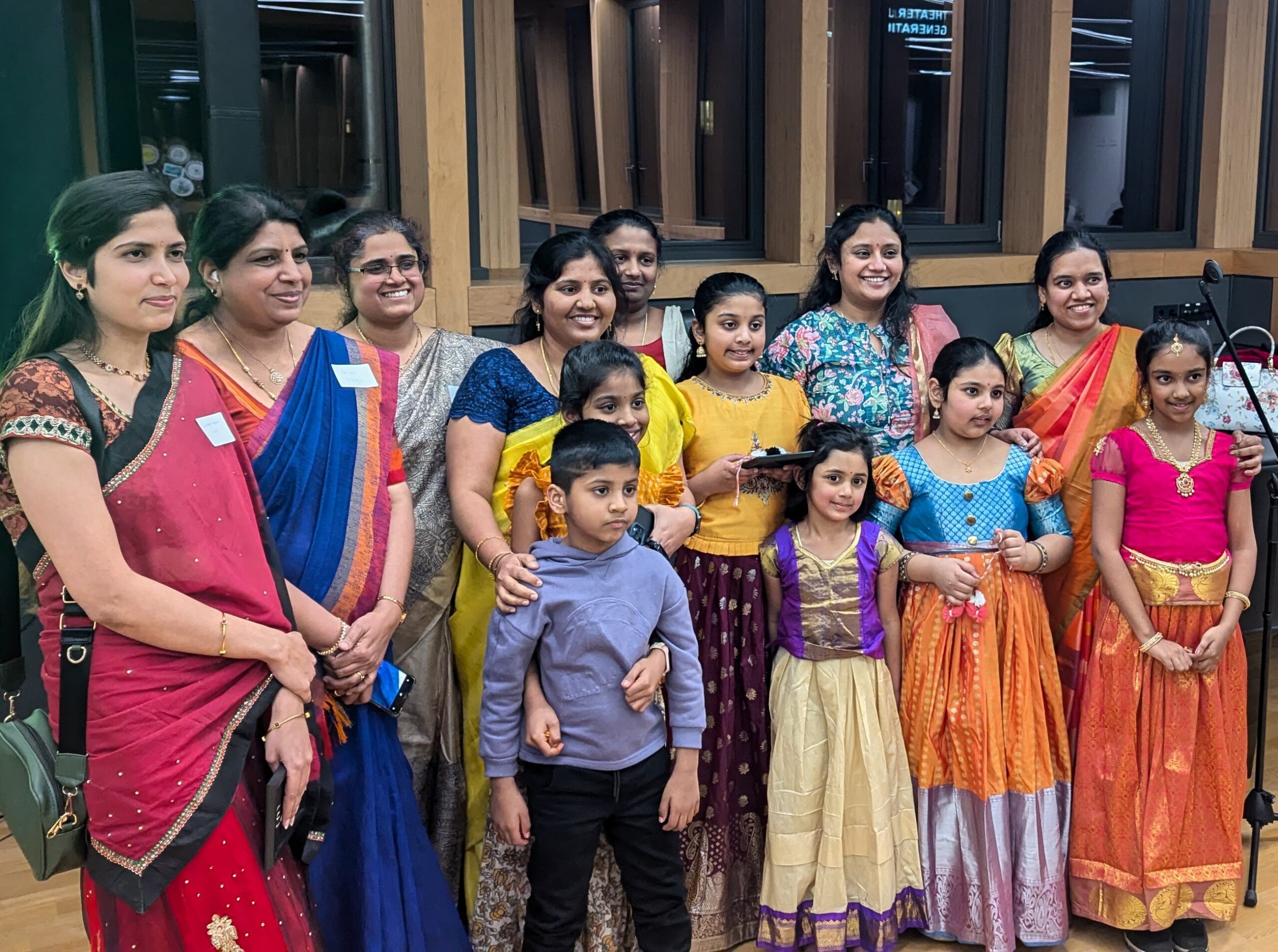
A friend of mine is from India, and for him it’s perfectly normal that seven languages are spoken in his hometown and that every child can at least understand all seven.
Birthe Mühlhoff
* in cooperation with Kolibri e.V. and Indian Association Dresden e.V.
ANSPRECHBAR
Wir sind ANSPRECHBAR – für ein besseres Miteinander! Wir bringen Menschen ins Gespräch – unabhängig von Sprache, Kultur, Alter, Geldbeutel oder sozialer Stellung – bei kreativen Workshops, Ausstellungen und in einem Interview-Magazin mit einfühlsamen Porträts. Seid dabei und lasst uns gemeinsam Brücken bauen!

Zeitraum
01-12.2025
Projektbeteiligte
Yvonn Spauschus (Projektleitung)
Yulia Vishnichenko · Moussa Mbarek · Nadine Wölk · Rosa Brockelt · Bela Álvarez (Workshopleitung)
Rosa Hauch · Birthe Mühlhoff (Moderation und Dokumentation)
Kooperationspartner:innen
JugendKunstschule Dresden – Standort Passage, Omse e.V., Malteser Hilfsdienste e.V., Montagscafé am Staatsschauspiel Dresden sowie Umweltzentrum Dresden – ABC Tische, Internationale Gärten Dresden e.V, Uniwerk e.V. (Pirna), Buntes Meißen Bündnis Zivilcourage e.V. und viele mehr
Gefördert durch
Das Projekt wird gefördert durch die Heidehof Stiftung GmbH und das Staatsministerium für Soziales und Gesellschaftlichen Zusammenhalt. Diese Maßnahme wird mitfinanziert mit Steuermitteln auf Grundlage des vom Sächsischen Landtag beschlossenen Haushaltes im Rahmen des Landesprogrammes Integrative Maßnahmen.